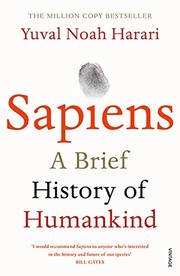
Books like Sapiens: A Brief History of Humankind
by Yuval Noah Harari · 2011
Updated June 2026
Book data: Open Library · Taste signals: BookTaste model
🌍 Sapiens is Harari's sweeping tour through 70,000 years of human history — from the Cognitive Revolution to the modern age — asking not just what happened but why our species came to dominate Earth. Fans love its audacity: it treats empires, religions, and capitalism as collective fictions that Homo sapiens collectively chose to believe. The prose is accessible but the ideas are genuinely unsettling, leaving readers rethinking everything from money to meaning.
Picked by taste overlap — not popularity alone.
What to read next

Guns, Germs, and Steel: The Fates of Human Societies
Jared Diamond · 1997
🌐 Big History🏛️ Civilisation📖 Accessible Science🌎 Diamond tackles the same grand question as Harari — why did some civilisations conquer others? — but grounds the answer in geography and biology rather than mythology, making it the most natural companion read.
- Matches
- big-picture civilisation history · why some societies dominate · accessible narrative nonfiction
- Differs
- more biological and geographic focus · less philosophical, more empirical · slower paced, denser chapters
- Skip if
- You wanted more philosophy and provocation and less environmental determinism — Diamond's thesis is tight where Harari roams freely.
Personalize with my booksNo signup · add a few books to build your radar
●●● strong · ●●○ medium · ●○○ light · ○○○ none
Solid = this book · dashed = Sapiens: A Brief History of Humankind

The Story of the Human Body: Evolution, Health, and Disease
Daniel Lieberman · 2013
🧠 Ideas-Driven📖 Accessible Science🔭 Long View🦴 Lieberman zooms in on the evolutionary mismatch Harari gestures at — how our Stone Age bodies struggle with modernity — and makes the case with precise anatomical detail that feels like a direct sequel to Sapiens' opening chapters.
- Matches
- human evolution across deep time · why modern life conflicts with biology · science written for general readers
- Differs
- narrowly focused on body and health · no economics or religion · more medical than historical
- Skip if
- You came for the sweep of politics and culture — this stays firmly in biology and medicine.
Solid = this book · dashed = Sapiens: A Brief History of Humankind
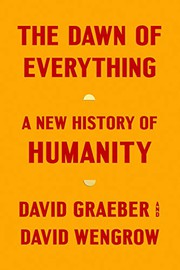
The Dawn of Everything: A New History of Humanity
David Graeber and David Wengrow · 2021
🌐 Big History💡 Contrarian Take🏛️ Civilisation🏺 Graeber and Wengrow mount the most direct intellectual challenge to Harari's narrative, arguing that early humans were far more politically inventive than the linear march from bands to states allows — essential reading for anyone who finished Sapiens wanting a counter-argument.
- Matches
- rethinking all of human history · big contrarian thesis about civilisation · long timescales, ideas as drivers
- Differs
- rejects Harari's neat story arc · much denser and more academic · political rather than biological framing
- Skip if
- You want a smooth, propulsive read — this is a 700-page scholarly argument that rewards patience, not pace.
Solid = this book · dashed = Sapiens: A Brief History of Humankind
Not similar books. Similar taste.
It reads the grain of every book you've loved — why it stayed with you — and follows that thread to your next read. Not the bestseller list, not the crowd: just your taste. Free, no signup.
Add books you've read; BookTaste builds your taste radar and recommends from it.
Taste radar — read from the themes shared across Sapiens: A Brief History of Humankind and the picks below
Strongest taste signals: 🌐 Big History · 🧠 Ideas-Driven · 🔭 Long View
How taste signals are generated
BookTaste's model reads the themes, moods, settings, and reader hooks of the base book, then scores every pick across those same axes — what overlaps, what diverges. Ordered by taste fit, not by popularity.
The Lessons of History
Will and Ariel Durant · 1968
🌐 Big History🏛️ Civilisation💡 Contrarian Take📜 This slim 100-page distillation of the Durants' eleven-volume civilisation epic does exactly what Harari does — extract the patterns that repeat across all of human time — and it does so with an elegance and economy that make it impossible to put down.
- Matches
- grand patterns across all of history · short, idea-dense, provocative · civilisation as a recurring drama
- Differs
- much shorter, almost aphoristic · written in 1968, dated in places · no evolutionary or biological lens
- Skip if
- You want contemporary science woven in — the Durants draw entirely on classical history and philosophy.
Solid = this book · dashed = Sapiens: A Brief History of Humankind

Goes deeper
The WEIRDest People in the World
Joseph Henrich · 2020
🧠 Ideas-Driven📊 Data-Heavy💡 Contrarian Take🧬 Henrich's thesis — that Western, Educated, Industrialised, Rich, Democratic psychology is a historical accident, not the human default — is the kind of paradigm-shifting idea Sapiens fans live for, backed by years of cross-cultural data.
- Matches
- culture shapes minds across history · big idea backed by rigorous research · rethinking what feels 'natural' to humans
- Differs
- more data-heavy and academic than Harari · narrower focus on Western psychology · less narrative, more argument-driven
- Skip if
- You prefer storytelling over tables and studies — Henrich is persuasive but demands more of the reader.
Solid = this book · dashed = Sapiens: A Brief History of Humankind
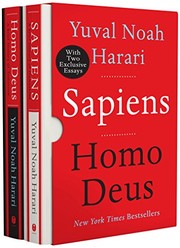
Homo Deus: A Brief History of Tomorrow
Yuval Noah Harari · 2015
🌐 Big History🧠 Ideas-Driven🔭 Long View🤖 The direct sequel to Sapiens, Homo Deus picks up exactly where the story left off — once we solved famine, plague, and war, what will humanity aim for next? — making it the most obvious next step for anyone who finished the first book wanting more.
- Matches
- same author, same sweeping style · futures built on deep historical patterns · provocative questions about human purpose
- Differs
- forward-looking speculation, not history · more unsettling and dystopian in tone · less grounded, more philosophical
- Skip if
- You were hoping to move on to a different author or discipline — this is essentially more Harari, with all the same strengths and weaknesses.
Solid = this book · dashed = Sapiens: A Brief History of Humankind
Frequently asked
- What kind of books are similar to Sapiens?
- Books in the same vein are big-history nonfiction — they zoom out to civilisational or evolutionary timescales and argue for a single unifying idea about why humanity turned out the way it did. Think Jared Diamond's Guns, Germs, and Steel or Daniel Lieberman's The Story of the Human Body — all rigorous enough to feel credible but written to be read in a sitting.
- Is there a sequel to Sapiens?
- Yes — Harari published Homo Deus in 2015 as a direct sequel, projecting where the human story goes next now that we've beaten famine and plague. He followed that with 21 Lessons for the 21st Century (2018), which is more a collection of essays than a narrative. Most readers find Homo Deus the stronger follow-up. 🤖
- What should I read if I want something more rigorously researched than Sapiens?
- Harari has been criticised for oversimplifying. If you want the same scale but tighter scholarship, try The Dawn of Everything by Graeber and Wengrow — it is a direct, evidence-based rebuke of the tidy hunter-gatherer-to-state narrative. *Joseph Henrich's The WEIRDest People in the World*** is also excellent and far more data-driven.
- Are there fiction books that give the same feeling as Sapiens?
- Not many fiction books match the sheer temporal scope, but The Clan of the Cave Bear by Jean M. Auel drops you into prehistoric human life with the same fascination for early Homo sapiens. For something more speculative, Kim Stanley Robinson's The Years of Rice and Salt reimagines all of human history — it's the closest fiction gets to big-history nonfiction. 🌍
Book data and covers from Open Library. Picks and taste signals are generated by BookTaste's taste model.