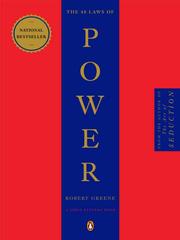
Books like The 48 Laws of Power
by Robert Greene · 1998
Updated June 2026
Book data: Open Library · Taste signals: BookTaste model
📖 The 48 Laws of Power is Robert Greene's ruthlessly pragmatic guide to the dynamics of power, influence, and manipulation — distilled from centuries of history, court intrigue, and political cunning. Fans are hooked by its cold-eyed realism: no moral sugarcoating, just patterns of how power actually works across conquerors, courtiers, and con artists. The blend of vivid historical case studies and distilled maxims makes it endlessly re-readable — equal parts strategy manual and dark sociology of ambition.
Picked by taste overlap — not popularity alone.
What to read next

The Art of War
Sun Tzu · -500
♟️ Power Strategy🌑 Dark Pragmatism♟️ The ancient text that Greene himself cites most often — pure strategic doctrine stripped of sentimentality, covering deception, positioning, and the psychology of conflict in the same cold, aphoristic register.
- Matches
- strategic deception over brute force · timeless power maxims · adversarial thinking
- Differs
- military context, not social/political · far shorter — one sitting read · no historical case studies
- Skip if
- You want rich historical storytelling alongside the maxims — this is pure doctrine with minimal narrative.
Find my next favorite readNo signup · add a few books to build your radar
●●● strong · ●●○ medium · ●○○ light · ○○○ none
Solid = this book · dashed = The 48 Laws of Power

Closest match
The Prince
Niccolò Machiavelli · 1532
♟️ Power Strategy🌑 Dark Pragmatism🏛️ Historical Depth🏛️ The book that invented realpolitik — Machiavelli advises rulers with the same unflinching honesty about power, fear, and reputation that Greene codified five centuries later, and Greene explicitly builds on it.
- Matches
- power without moral pretense · historical rulers as case studies · calculated image management
- Differs
- focused on state governance, not personal power · much shorter and denser · no modern examples
- Skip if
- You need practical modern applicability — this stays in Renaissance political theory throughout.
Solid = this book · dashed = The 48 Laws of Power

The 33 Strategies of War
Robert Greene · 2006
♟️ Power Strategy🏛️ Historical Depth🌑 Dark Pragmatism♟️ Greene's direct sequel in spirit — same forensic case-study format, same historical sweep, but reframes power as martial strategy: offense, defense, and the psychology of the enemy.
- Matches
- identical case-study + law format · adversarial power dynamics · historical and modern examples
- Differs
- conflict and warfare framing, less social manipulation · longer and denser · more military history
- Skip if
- You want new ideas beyond Greene's formula — same author, same method, diminishing novelty.
Solid = this book · dashed = The 48 Laws of Power
Not similar books. Similar taste.
It reads the grain of every book you've loved — why it stayed with you — and follows that thread to your next read. Not the bestseller list, not the crowd: just your taste. Free, no signup.
Add books you've read; BookTaste builds your taste radar and recommends from it.
Taste radar — read from the themes shared across The 48 Laws of Power and the picks below
Strongest taste signals: ♟️ Power Strategy · 🌑 Dark Pragmatism · 🏛️ Historical Depth
How taste signals are generated
BookTaste's model reads the themes, moods, settings, and reader hooks of the base book, then scores every pick across those same axes — what overlaps, what diverges. Ordered by taste fit, not by popularity.
Influence: The Psychology of Persuasion
Robert B. Cialdini · 1984
🎭 Human Nature🤝 Social Dynamics🎭 Where Greene mines history, Cialdini mines social psychology experiments — six universal levers of influence (reciprocity, scarcity, authority, etc.) that explain the mechanisms behind many of Greene's laws with scientific rigor.
- Matches
- understanding how people are manipulated · practical social leverage · defense as well as offense
- Differs
- scientific rather than historical approach · lighter and more accessible tone · no dark pragmatism — ethics-aware
- Skip if
- You want the amoral thrill of Greene's prose — Cialdini is warmer, more academic, and ethically balanced.
Solid = this book · dashed = The 48 Laws of Power

Meditations
Marcus Aurelius · 180
💡 Self-Mastery🏛️ Historical Depth💡 The stoic counterweight that many 48 Laws readers reach for next — a ruler's private journal on self-mastery, discipline, and the limits of power, written by someone who actually held absolute power and found it insufficient.
- Matches
- power and its psychological cost · historical ruler perspective · timeless aphoristic wisdom
- Differs
- inner discipline, not external manipulation · deeply philosophical and introspective · no tactical advice
- Skip if
- You want tactics and cunning — Meditations teaches restraint and virtue, the opposite of Greene's playbook.
Solid = this book · dashed = The 48 Laws of Power
The Lessons of History
Will Durant and Ariel Durant · 1968
🏛️ Historical Depth📜 Narrative Case Studies🏛️ A distilled 100-page extraction from the Durants' 11-volume Story of Civilization — sweeping patterns of power, war, economics, and morality across millennia, the exact kind of macro historical synthesis that underlies Greene's case studies.
- Matches
- patterns of power across civilizations · historical depth and sweep · concise distilled wisdom format
- Differs
- no strategic advice — descriptive, not prescriptive · broader scope: economics, religion, biology · scholarly rather than pragmatic tone
- Skip if
- You want actionable power tactics — this is philosophical history, not a strategy manual.
Solid = this book · dashed = The 48 Laws of Power
Frequently asked
- Is The 48 Laws of Power actually useful or just cynical entertainment?
- Both, and that tension is the point. The strategic frameworks are genuinely applicable — understanding how reputation, timing, and perceived strength shape outcomes matters whether you're in a boardroom or a negotiation. But Greene writes with a provocateur's edge, so treat it as a map of how power can work, not a moral instruction manual.
- What should I read after The 48 Laws of Power if I want more of the same author?
- Greene wrote a whole series in this vein: The 33 Strategies of War applies the same case-study method to conflict and competition; The Art of Seduction covers influence through desire; Mastery is the most practical for career-builders. Most readers go to The 33 Strategies next — it's the closest match in format and tone.
- Are there books like The 48 Laws of Power but more ethical or positive?
- Yes — Influence by Cialdini covers the same psychological levers but from a defensive and ethically aware angle. Never Split the Difference by Chris Voss adapts FBI negotiation tactics into everyday persuasion without the amorality. If you want power through virtue rather than cunning, Marcus Aurelius's Meditations is the ancient counterpoint Greene's readers often circle back to.
- Is The 48 Laws of Power based on real history or made up?
- The historical examples are real — Greene draws on documented episodes involving figures like Cardinal Richelieu, Talleyrand, Queen Elizabeth I, and countless others. The framing as numbered laws is Greene's editorial architecture, not ancient doctrine. His sources are solid; the interpretive lens is intentionally one-sided toward power as an end in itself.
Book data and covers from Open Library. Picks and taste signals are generated by BookTaste's taste model.